Learning Outcomes
i. Master the fundamental distinctions between electrolytic and voltaic cells, comprehending their contrasting energy conversion processes.
ii. Identify the key components of each type of cell, including electrodes, electrolyte, and external energy source.
iii. Understand the direction of electron flow and the nature of chemical reactions in both electrolytic and voltaic cells.
iv. Differentiate between spontaneous and non-spontaneous reactions based on their ability to occur without an external energy input.
v. Recognize the diverse applications of electrolytic and voltaic cells in various fields.
Introduction
In the captivating realm of electrochemistry, where chemical energy dances with electrical energy, electrolytic and voltaic cells emerge as contrasting yet interconnected devices. While both types of cells harness the power of chemical reactions to generate electricity, they differ in their fundamental principles and applications. This lesson will embark on a journey of distinction, illuminating the key differences between electrolytic and voltaic cells.
i. Electrolytic Cells: Driving Non-Spontaneous Reactions
Electrolytic cells are ingenious devices that utilize an external electrical energy source to drive non-spontaneous chemical reactions. The external energy input overcomes the activation energy barrier, allowing the reaction to proceed.
Key Components of Electrolytic Cells:
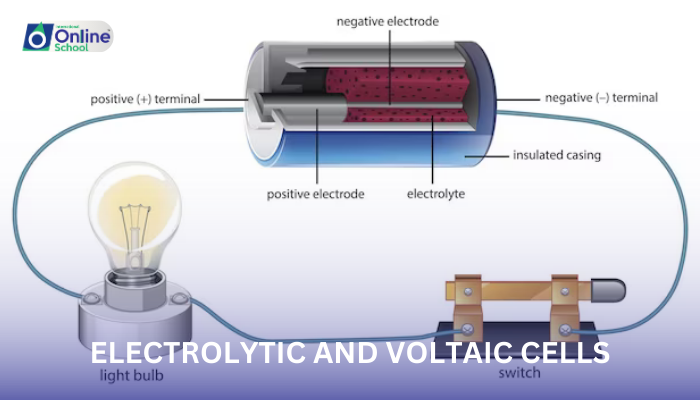
Electrodes: The anode, the site of oxidation, and the cathode, the site of reduction.
Electrolyte: A conductive solution containing ions that facilitate the movement of electrons between the electrodes.
External electrical energy source: Provides the energy to drive the non-spontaneous reaction.
ii. Voltaic Cells: Harnessing Spontaneous Reactions
Voltaic cells, also known as galvanic cells, are spontaneous electrochemical cells that convert chemical energy into electrical energy. In contrast to electrolytic cells, voltaic cells do not require an external energy input; instead, they harness the energy from spontaneous redox reactions occurring at the electrodes.
Key Components of Voltaic Cells:
Electrodes: The anode, where oxidation occurs, and the cathode, where reduction occurs.
Electrolyte: A conductive solution containing ions that facilitate the movement of electrons between the electrodes.
Salt bridge: A porous membrane that maintains electrical neutrality by allowing ion flow between the electrolyte solutions in the anode and cathode compartments.
Electrolytic Cells Applications:
Electroplating: Depositing a metal onto a cathode from an ionic solution.
Refining metals: Extracting pure metals from their ores.
Chemical synthesis: Producing various chemicals, such as chlorine and sodium hydroxide.
Voltaic Cells Applications:
Batteries: Powering portable electronic devices and vehicles.
Corrosion protection: Preventing the deterioration of metals.
Fuel cells: Generating electricity directly from chemical reactions.
Electrolytic and voltaic cells, though sharing the common thread of electrochemistry, exhibit contrasting features. Electrolytic cells utilize external energy to drive non-spontaneous reactions, while voltaic cells harness the power of spontaneous redox reactions to generate electrical energy. Understanding the distinctions between these cells, their components, and their diverse applications empowers us to appreciate the intricate interplay of chemistry and electricity in shaping our world.
